
European Interdisciplinary Cybersecurity Conference
Darmstadt University of Applied Sciences [h_da]
Darmstadt, Germany
News
-
13 July 2026
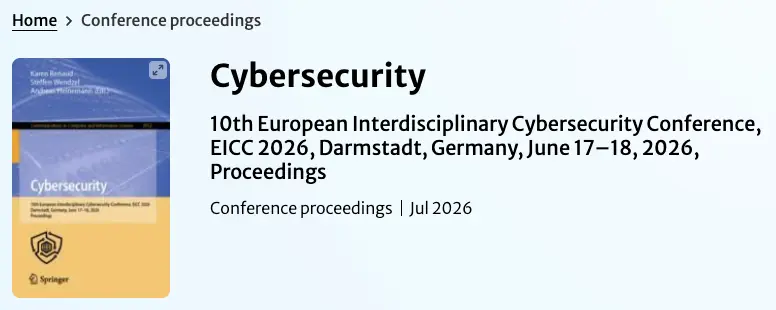
EICC 2026 proceedings have been published by Springer.
-
19 June 2026
This year’s EICC Best Paper Award goes to Mario Hoffmann and Erik Buchmann for their paper “Cyber Resilience through LLM-Enhanced Vulnerability Reports”. Congratulations.
See you at EICC 2027, to be held next year in Paris, France.
-
16 April 2026
Travel and accommodation information is now available. Please visit the Travel and accommodation page for more information.
-
15 April 2026
Conference program is now available. Please visit the Conference program page for more information.
-
13 April 2026
Registration for EICC 2026 is now open. Please visit the Registration page for more information.
-
23 February 2026
CyFRP special session submission deadline has been extended to 8 March 2026 [AoE].
-
19 January 2026
Submission deadline has been extended to 28 January 2026 [AoE].
About the conference

EICC 2026 aims at establishing a premium venue for the exchange of information and sharing of research findings on cybersecurity and its many aspects between academics and practitioners in Europe. EICC 2026 encourages the dialogue between computer scientists and researchers in all other fields related to cybersecurity, such as behavioral sciences, sociology, criminology, investigations and law. Interdisciplinary contributions are especially welcome.
EICC 2026 is the 10th edition of the conference, which until 2019 was known as the Central European Cybersecurity Conference – CECC, being rebranded to underscore the interdisciplinarity of the conference and broaden its reach.
EICC 2026 is planned as a face-to-face conference.
EICC 2026 proceedings will be published in Springer Communications in Computer and Information Science (CCIS), indexed by dblp and Scopus.
Important dates
Submission deadline (extended)
Author notification
Camera-ready
Main author / presenter registration deadline (accepted papers)
Early-bird registration deadline
Registration deadline
Keynote Speakers
-

Ganna Pogrebna
Cognitive Bias as a Cybersecurity Vector
Cybersecurity discussions frequently describe attacks that exploit human behaviour under the label of social engineering. While useful, this framing obscures a deeper mechanism: many cyber incidents succeed because attackers exploit predictable cognitive biases in human judgement.
This talk argues that cognitive bias should be understood as a distinct cybersecurity vector embedded within modern digital systems. Biases such as confirmation bias, automation bias, authority bias, and availability bias influence how analysts interpret alerts, how organisations prioritise threats, and how users respond to suspicious signals. These behavioural tendencies shape decision-making across the entire cybersecurity pipeline—from threat detection and incident response to strategic risk assessment. As AI-assisted tools increasingly support cyber operations, these biases may be amplified rather than reduced, particularly when humans over-trust automated recommendations or fail to question machine-generated outputs.
Recognising cognitive bias as a structural vulnerability enables a broader interdisciplinary perspective on cybersecurity, integrating insights from behavioural science, decision theory, and human-machine interaction into the design of more resilient cyber defence systems.
Ganna Pogrebna is a behavioural data science pioneer working at the intersection of cybersecurity, artificial intelligence, and decision theory. She holds the David Trimble Chair in Leadership and Organisational Transformation at Queen's Business School, where her research focuses on the human and organisational dimensions of cybersecurity, including behavioural vulnerabilities, AI-enabled cyber risk, and decision-making in complex digital systems. Her work integrates insights from behavioural science, economics, and computer science to understand how human judgement interacts with intelligent systems in cybersecurity environments. Professor Pogrebna has published over 120 peer-reviewed papers and secured more than $30 million in competitive research funding. She advises governments and industry on behavioural cybersecurity and responsible AI and has received several international awards, including the Women in AI APAC Award in Risk Modelling and Cybersecurity and the AI in Cybersecurity Champion Award.
-

Dominik Herrmann
n = 7 – and that's the point
In a German household in 2023, a man proudly demonstrates his robot vacuum's surveillance camera to an ethnographer. His partner asks him three times to turn it off. He bought the device. It sits in their living room. She does not want it. This is not a security incident in any conventional sense - yet no authentication scheme, no threat model, and no behavioural-bias taxonomy captures what is actually happening here.
In this talk, I report from the Bavarian research consortium ForDaySec, where computer scientists and ethnographers, among others, learned how to collaboratively study how people actually live with their digital devices. I will argue that lovingly neglected home networks, devices arriving as unwanted gifts, and security delegated to sons-in-law are not edge cases but the norm - while our field has been studying lab-based approximations of these situations for decades.
I will also speak honestly about the costs: publication friction, method clashes, career risk for junior researchers. And I will end with a small request to a community that prides itself on rigour: dare more qualitative research. n = 7 is sometimes exactly the right number.
Dominik Herrmann holds the chair of Privacy and Security in Information Systems at the University of Bamberg, Germany. His research focuses on privacy-enhancing technologies, usable security and digital education. He publishes in leading international venues such as CHI, USENIX Security and PETS. He is the spokesperson for the CIO at the University of Bamberg and Dean of the Faculty of Information Systems and Applied Computer Sciences.
Call for papers
Scope
The conference is devoted to exploring and presenting original innovative applications, scientific and technological advancements in the field of cybersecurity. Topics for this conference include, but are not limited to:
- Accessible and inclusive cybersecurity
- Artificial Intelligence (AI) applied to cybersecurity
- Artificial Intelligence (AI) trustworthiness
- Big data and privacy
- Business continuity and incident response
- Child cybersecurity and privacy
- Cloud security
- Critical infrastructure security
- Cyber forensics
- Cyber insurance
- Cyber leadership
- Cyber warfare
- Cyber-physical systems security
- Cybersecurity and cyber resilience
- Cybersecurity culture
- Cybersecurity responsibilisation
- Cybersecurity incident reporting
- Digital currency, blockchains and cybercrime
- Digital privacy
- Embedded systems security
- Healthcare information security and privacy
- Human cybersecurity decision making
- Information security governance
- Internet of Things (IoT) privacy and security
- Law, investigation, internet jurisdiction and ethics
- Mobile security
- Network security
- Security management
- Software development security
- Surveillance, interception, blocking and sovereignty
- Trust management
- Whistleblowing
Publication
EICC 2026 proceedings will be published by Springer Nature in the Communications in Computer and Information Science (CCIS) series: CCIS, volume 3012. The proceedings will be available online from Springer at the conference's start.
Submission guidelines
The official language of the conference is English. Papers (references included) are limited to 16 pages and up to 4 additional pages with mandatory surcharges.
All papers must be original and not simultaneously submitted to another journal or conference. Authors are expected to adhere to the best practices in terms of scientific integrity as mentioned in the Publishing Ethics section of the guidelines. The following paper categories reporting on original research findings are welcome:
Full papers
(12-16+ pages)
Short papers
(6-11 pages)
Papers submitted to EICC 2026 have to use the Springer Lecture Notes in Computer Science Proceedings Template. Please, read template instructions carefully before submitting the paper. The use of the LaTeX template is strongly encouraged. Non-proficient LaTeX users are encouraged to use the Overleaf online collaborative Latex platform (LaTeX2e Proceedings Templates on Overleaf).
The quality of the research papers will be assessed based on its originality, significance and clarity. All submitted research papers will undergo a double-blind reviewing process. Please, make sure that submitted papers do not contain author names or obvious self-references (e.g., self-citations, project funding statements, institutional review board names). Please note that the page limit applies to camera-ready papers with author names included and not the submitted anonymized version. Each paper will be reviewed by at least three reviewers. Afterwards, a discussion will be held by the chairs and reviewers to determine the outcomes of the peer-review.
Submission of a paper implies that at least one of the authors will register and present the paper at the conference if the paper is accepted.
Submission of papers should be performed using the EasyChair EICC 2026 submission system.
Full papers can exceed the page limit by a maximum of 4 pages. Each additional page above the page limit will be charged on top of the registration fee.
Committees
Conference chair
Andreas Heinemann
Darmstadt University of Applied Sciences (Germany)
eicc2026@easychair.org
Program committee co-chairs
Karen Renaud
Strathclyde University (UK)
eicc2026@easychair.org
Steffen Wendzel
Ulm University (Germany)
eicc2026@easychair.org
Program committee
Habtamu Abie
Norwegian Computing Centre (Norway)
Marios Anagnostopoulos
Democritus University of Thrace (Greece)
Niyati Baliyan
National Institute of Technology Kurukshetra (India)
João Paulo Barraca
University of Aveiro (Portugal)
Simona Bernardi
Universidad de Zaragoza (Spain)
Luca Caviglione
CNR - IMATI (Italy)
Michał Choraś
Bydgoszcz University of Science and Technology (Poland)
Kovila Coopamootoo
King’s College London (UK)
Luca Davoli
University of Parma (Italy)
Changyu Dong
Newcastle University (UK)
Pavlos Efraimidis
Democritus University of Thrace (Greece)
Tobias Eggendorfer
TH Ingolstadt (Germany)
Sergio Esposito
Università degli Studi di Catania (Italy)
Virginia Franqueira
University of Kent (UK)
Damjan Fujs
University of Ljubljana (Slovenia)
Steven Furnell
University of Nottingham (UK)
Dieter Gollmann
Hamburg University of Technology (Germany)
Petra Grd
University of Zagreb (Croatia)
Nils Gruschka
University of Oslo (Norway)
Piroska Haller
Petru Maior University (Romania)
Marko Hölbl
University of Maribor (Slovenia)
Pedro Inácio
Universidade da Beira Interior (Portugal)
Martin Gilje Jaatun
University of Stavanger & SINTEF Digital (Norway)
Georgios Karopoulos
European Commission, Joint Research Centre (Italy)
Stefan Katzenbeisser
University of Passau (Germany)
Wenjuan Li
Education University of Hong Kong (China)
Shigang Liu
CSIRO's Data61 (Australia)
Brad Malin
Vanderbilt University (US)
David Megías
Internet Interdisciplinary Institute (IN3) & Universitat Oberta de Catalunya (Spain)
Weizhi Meng
Lancaster University (UK)
Pal-Stefan Murvay
Politehnica University of Timisoara (Romania)
Sebastian Pape
Social Engineering Academy GmbH (Germany)
Sergio Pastrana
Universidad Carlos III de Madrid (Spain)
Isabel Praça
GECAD / ISEP (Portugal)
Tobias Schmidbauer
Nuremberg Institute of Technology (Germany)
Bernardo Sequeiros
Universidade da Beira Interior (Portugal)
Anastasia Sergeeva
University of Luxembourg (Luxembourg)
Juraj Sikra
Karlsruhe Institute of Technology (Germany)
Gerardo Simari
Universidad Nacional del Sur & CONICET (Argentina)
Kai Simon
Fraunhofer-Gesellschaft (Germany)
Michael Sirivianos
Cyprus University of Technology (Cyprus)
Florian Skopik
Austrian Institute of Technology (Austria)
Hung-Min Sun
National Tsing Hua University (Taiwan)
Sotirios Terzis
University of Strathclyde (UK)
Igor Tomičić
University of Zagreb (Croatia)
Fernando Tricas
Universidad de Zaragoza (Spain)
Nicolas Tsapatsoulis
Cyprus University of Technology (Cyprus)
Christos Xenakis
University of Piraeus (Greece)
Nicola Zannone
Eindhoven University of Technology (Netherlands)
Sebastian Zillien
Ulm University (Germany)
Local organizing co-chairs
Andreas Heinemann
Darmstadt University of Applied Sciences (Germany)
eicc2026@easychair.org
Sara Hahn
Darmstadt University of Applied Sciences (Germany)
eicc-2026-local-chairs.fbi@news.h-da.de
Treasury
Simone Zimmermann
CAST e.V. (Germany)
eicc26@cast-forum.de
Local organizing team
UCS Research Group
Darmstadt University of Applied Sciences (Germany)
Steering committee
Igor Bernik
University of Maribor (Slovenia)
Bela Genge
University of Medicine, Pharmacy, Sciences and Technology of Tg. Mures (Romania)
Jörg Keller
FernUniversität in Hagen (Germany)
Blaž Markelj
University of Maribor (Slovenia)
Aleksandra Mileva
University Goce Delcev (North Macedonia)
Wojciech Mazurczyk
Warsaw University of Technology (Poland)
Simon Vrhovec
University of Maribor (Slovenia)